.png)

You’ve grown past the earliest solve-everything-inhouse stage. You’re proud of what you’ve built so far, you’ve got traction in the market and some customers.
But you’ve hit a ceiling.
The word-of-mouth strategy that got you here isn’t going to get you there. Growth is slowing but at the same time, you’re being pulled in dozens of directions, putting out spot fires with your team, your product and customers and trying to spin up some marketing activity, even if it’s just a LinkedIn post or two.
You know you need marketing but you hit the inevitable fork in the road:
Do we hire for marketing in-house or get outsourced support?
With that comes a stream of questions:
- How senior would a hire need to be?
- Can I just get an intern or freelancer?
- What do we actually need done?
- Where do we start?
It’s all too hard so you kick the marketing can down the road again until… sales really start drying up. This is often when founders and business leaders realise marketing is not a switch you can just turn on to stoke sales back into action.
So, before you get to that point, take stock of your marketing needs and consider how to solve them best for the stage your business is at. With the right support, marketing can help unlock your next stage of growth. Here, we look at the differences between in-house and outsourced marketing support, and how to decide what’s right for you.
What are the different types of in-house and outsourced marketing support?
Marketing is an extremely broad professional discipline, covering everything from branding and strategy through to website development, data analytics, digital advertising and event management.
In-house marketers are often:
- Generalists, with an overall understanding of most marketing areas but limited ability to execute on many
- Reliant on hiring specialists to deliver on particular areas of marketing
- Pulled in many directions, often without a clear strategy
- Forced to prioritise speed over polish
In larger businesses, marketing departments split out into different functional areas. This diagram provides a snapshot view of this.
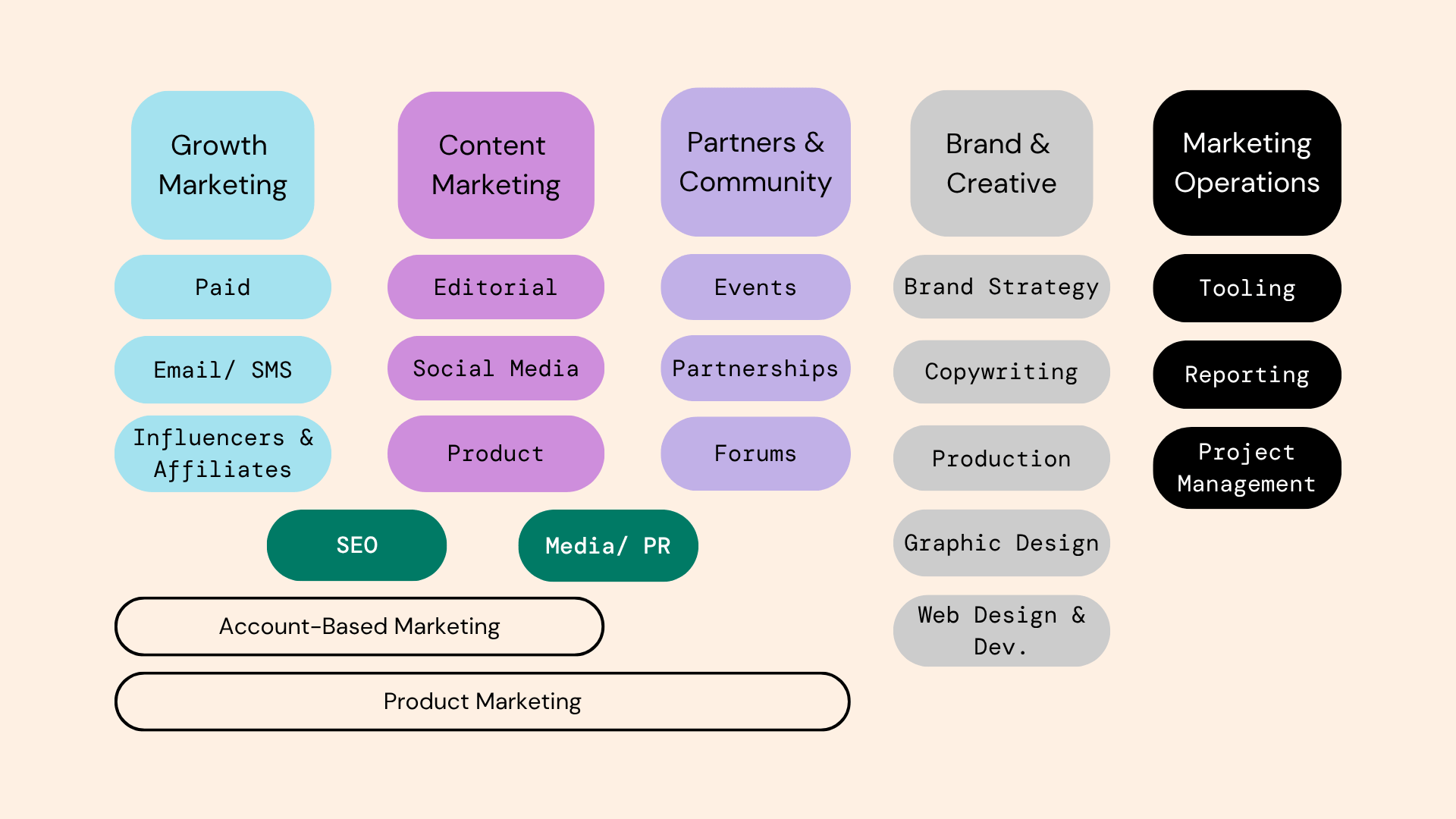
Obviously, this is not realistic for startups and growing businesses, hence why they often look to solve marketing with outsourced support.
Outsourced marketing support is available in a variety of ways, mainly:
- Agencies that help with particular projects, such as brand and website design/development or PR campaigns
- Fractional CMOs (Chief Marketing Officers), who provide high-level strategy and leadership on a retainer or project basis but don’t usually deliver executional work or campaigns
- Freelancers who deliver particular areas of marketing, such as content or social media
- Interns who are similar to freelancers but usually with a lot less experience and expertise
There is also another option, which we offer at Stella Startups – a fully outsourced marketing service including CMO strategy through to a full-stack fractional team to deliver the work.
What does your marketing need to be effective?
Regardless of whether you have in-house or outsourced support, marketing requires three things to be successful: Knowledge, skills and capacity.
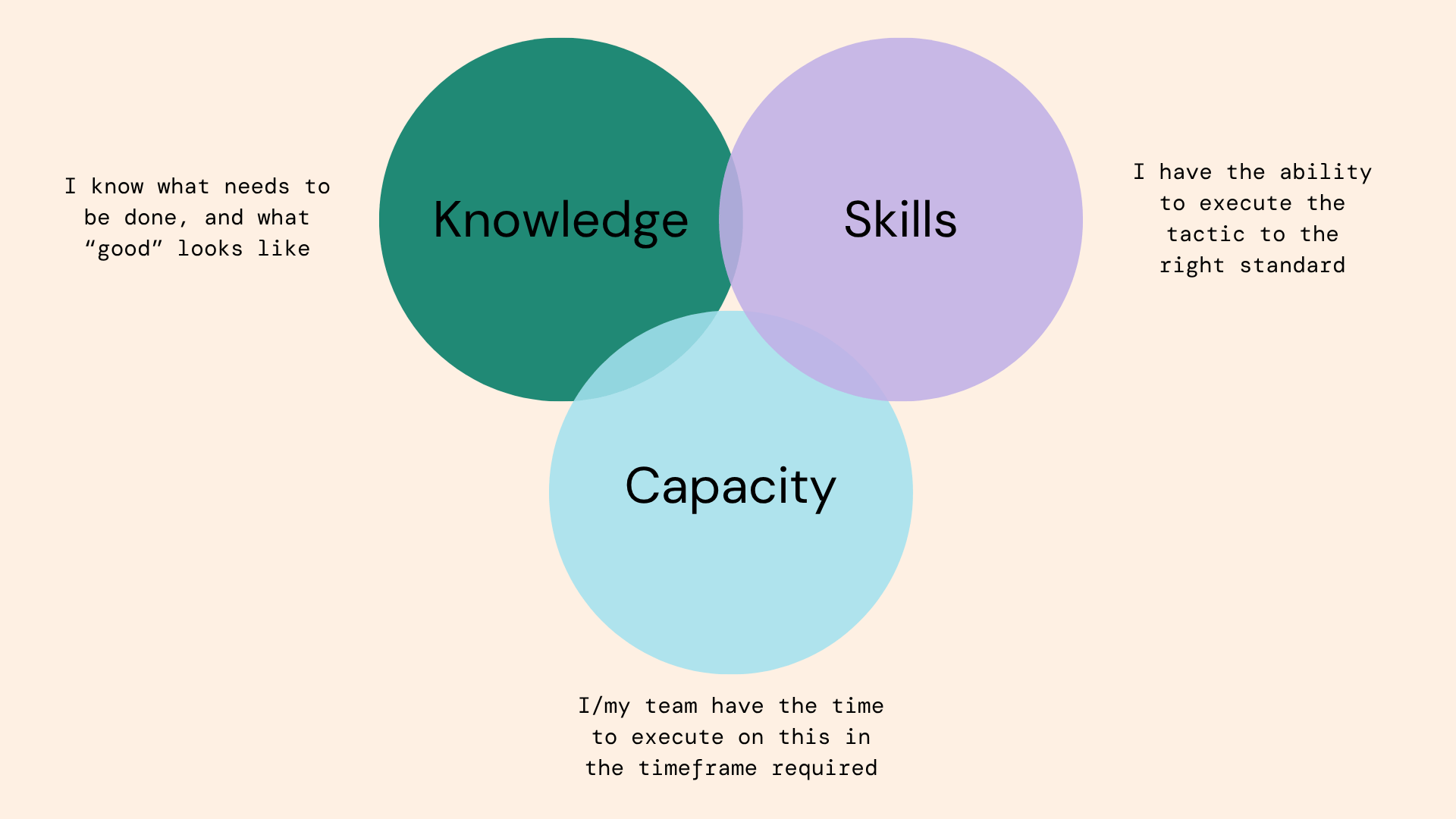
We call this the marketing trifecta, and it rarely (if ever) exists in one person.
For example, a fractional CMO is usually strong in knowledge with some capability if they’re doing hands-on marketing work but not able to deliver at a significant capacity. Meanwhile, a freelance specialist will have skills in their particular area of expertise, but usually lack broader marketing knowledge and their capacity is time bound.
Let’s break this down further.
Knowledge
Do you know what you need when it comes to marketing? For example, do you know whether SEO, PR or paid ads is the right strategy for your business right now? If you have a hunch, do you know what “good” looks like in these areas?
Marketing knowledge (i.e. being an expert in marketing) is the first important factor to consider before deciding the type of support you need. Some founders are ex-marketers and are well positioned to guide their own marketing strategy. But even in these cases, they often have a marketing background in a different industry or business model and lack some of the most up-to-date knowledge required to set and execute on a strategy for their business.
Your degree of marketing knowledge will determine the seniority and background of the person or team you need to bring in to support you. If you’re not familiar with best-practice knowledge to guide strategy and review work to ensure it’s up to standard, you’ll need someone who is, usually a senior marketer (8+ years experience) who’s worked on a similar product to yours before.
Not “knowing what you don’t know” remains one of the biggest traps for founders and business leaders today, in all areas. In this era, knowledge seems easy to come by. Ask AI what you need to do, and it will do a pretty convincing job of telling you. But, unless you have a background in marketing, you’re looking at it without the knowledge needed for proper assessment and you risk following generic playbooks and advice being dished out to countless others.
Skills
Expecting to hire a single person who’s an expert across all streams of marketing (strategy, content, paid media, SEO, brand, design, analytics, etc, etc.) is unrealistic (sorry!). Especially in a fast-moving tech startup or business.
Many non-marketer founders underestimate the technical skills needed to execute on the very broad church of marketing skills, thinking that everyone in the general marketing realm is able to shapeshift and learn on the fly.
The reality is, no matter how smart the person you hire is, their output will be slower and of a lower quality if they have little to no practical experience executing on a particular area of marketing. Upskilling is possible, but takes time.
Capacity
This is where most founders and teams feel the pinch.
Even with the right knowledge and skills, marketing still requires time. Campaigns take longer than expected, priorities shift, “quick win” requests stack up and strategy slips.
Many capable and driven founders and business leaders - especially those with a marketing background - start out trying to DIY their marketing, only to realise it’s taking over the time they should be spending on other areas. If you're a founder and intend to be the CEO, not CMO + Content Marketer + Marketing Operations Specialist, you need to consider handing over the reins, at least from an executional stand-point and sometimes for strategy too, to ensure it gets the love needed to succeed.
Your in-house capacity is fixed. When internal teams are busy but marketing needs to stretch further to support business goals, outsourced options are worth considering for dialled-in support without increasing FTE overheads.
How do in-house and outsourced marketing costs differ?
It’s easy to look at hiring in-house as a simple salary cost. But also consider:
- Recruitment costs
- Salary package (e.g. $140,000 for a mid-level marketer)
- Entitlements, such as annual and sick leave
- Equipment, software, desk space
- Onboarding and ramp up time of 2-3 months typically
Outsourced marketing costs vary widely, depending on type. Here are some examples:
- Agencies: Costs vary widely depending on the project but expect brand work to cost min. $20,000 and likewise for website design and development
- Fractional CMOs: Hourly rates typically start at about $180/hour
- Freelance specialists: Rates depend on the area of marketing (e.g. copywriting, social, content, design) but typically range from $50-$150/hour
- Interns: We almost didn’t include this because unless you have inhouse marketing expertise to set strong strategy plus a lot of time to mentor and guide an intern, this is not a viable option. But if you do, expect hourly rates of ~$35.
Our outsourced marketing service also fits here, and you can see pricing options on our services page.
While outsourced options are not all created equal, you should be paying for outcomes and also have more flexibility to turn support on/off and scale it up/down to capture momentum and avoid missing opportunities.
Other pros and cons of outsourced and in-house marketing
In-house marketing teams often evolve organically. Someone decides you need a designer, later a growth marketer then maybe a content hire. The team grows but often without a clear strategy to plan ahead for what’s next.
When you work in-house (as the founder, business leader or dedicated marketer) you’re immersed in one brand and one product, 365 days a year. That deep context is valuable but it also creates blind spots. You can get stuck inside the bubble of thinking ‘what would this brand do’ rather than ‘what else could we do that could challenge or disrupt the category.’
Outsourcing brings a different perspective. Working across industries, stages and various challenges, outsourced support has the benefit of fresh eyes and ideally, insight about what’s working in the market right now. Beyond execution, good outsourced marketing support should contribute to:
- Strategic positioning
- Go-to-market (GTM) thinking
- Process improvements
- Audience definition and capturing
That outside perspective can be hard to maintain internally when day-to-day needs take over.
On the other hand, those in-house often have a deep understanding of the product, customer and brand story, plus knowledge of any internal challenges or priorities.
So which is better: In-house or outsourced marketing?
The honest answer is: it depends.
Both have pros and cons, but if your business is at the stage where it can only afford one internal marketing hire with very limited external support for that person, in our experience this is rarely a recipe for success because you’re expecting too much of that hire. In other words, they’re unlikely to be a marketing unicorn with solid strategic experience through to data dashboard skills and content wizardry.
At this stage, your business might be better off outsourcing marketing until you can afford to build out your internal team properly, so they can succeed and truly support your business goals.
Outsourced marketing support should not just bridge this gap, but help close it for you by:
- Establishing strong marketing foundations that internal hires can run with
- Building everything with enablement and handover in mind
- When the time comes, helping you identify the best first marketing role to hire for and even helping screen candidates
. . . . . . . . . . . . . . . . . . . . . . . . . . . . . . . . . . . . . . . . . . . .
Still have questions? We’re happy to help. Talk to Bridget or Gemma from our team.
See related articles

So you bought a booth at an important conference… now what?


WTF is AEO and should startup founders care?


When (and how) should DeepTech startups invest in marketing?
Ready to make sense of marketing?